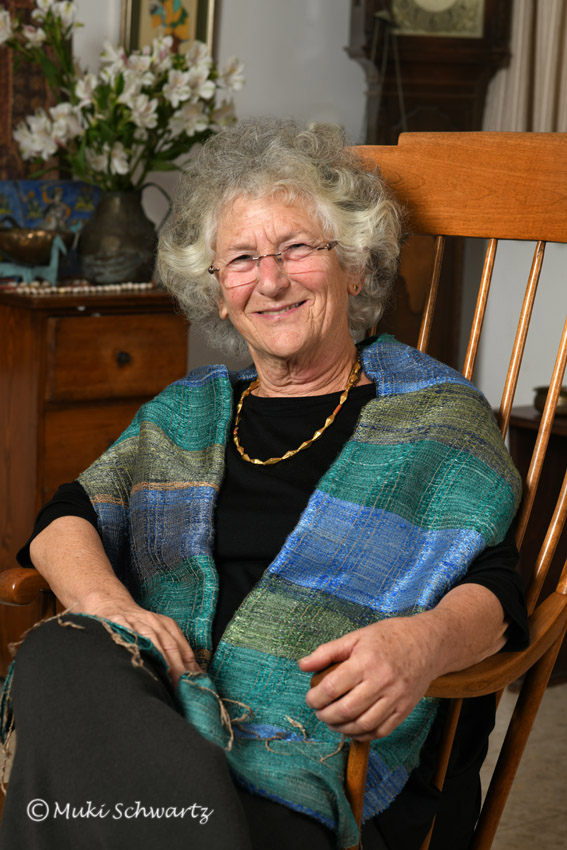
Prof. Deborah Bernstein
Professor Emerita · University of Haifa

Deborah
Bernstein

Sociologist and social historian whose work has reshaped our understanding of Israeli society — its gender relations, ethnic divides, labor history, and colonial legacies from Mandate Palestine to early statehood.

About

Biography

Deborah Bernstein was born in Chicago in 1944. When she was three years old, her family immigrated to Israel, where she has lived ever since. She attended the Hebrew Reali School in Haifa and went on to study sociology and psychology at the Hebrew University of Jerusalem, earning both her bachelor's and master's degrees there.

She completed her doctoral dissertation at the University of Sussex in 1976, writing on the Black Panthers of Israel (1971–1972) — a protest movement of Mizrahi Jews who challenged social and political inequalities in a society dominated by Ashkenazi elites. This early work announced a scholarly voice committed to those at the margins of Israeli society.

Since 1976–77 Bernstein has been a member of the Department of Sociology and Anthropology at the University of Haifa, where she spent her entire career, retiring as Professor Emerita in 2012. She chaired the Women's Studies Program from 1997 to 2002, and served as a Visiting Scholar at the Lipinsky Institute for Judaic Studies at San Diego State University in 1987–88.

Her scholarship is distinguished by an innovative combination of sociological and historical methods. Across decades she investigated gender inequality in the labor market, the social history of women workers in the Yishuv, the formation of ethnic divisions between Ashkenazim and Mizrahim in the early state, the complex relations between Jews and Arabs in Haifa and Jaffa under British rule, and the intersection of colonial law with issues of gender and national identity.

In 1978, Bernstein co-founded — together with Shlomo Swirski, Devora Kalkin, and Henry Rosenfeld — the journal Makhbarot le-Mehkar u-Vikoret (Notebooks for Research and Criticism), the first critical sociological journal published in Hebrew in Israel. This initiative marked a formative moment in the development of critical sociology in Israel.

Her research and writing have demonstrated an interplay of sociology and social history, gender study and at times – the history of law and the judicial system. She has published in English and in Hebrew, so as to make her work accessible both to the academic world and to the members of the society about which she writes. Her work on sociological and historical issues in both mandate Palestine and early statehood, opened new and often contentious perspectives about the foundations of Israeli society. Her focus on the margins of society has been one of the main characteristics of her academic contribution. She is recognized as one of the founders of critical sociology in Israel. In 2019 she was awarded the Israel Prize — the country's highest award for Sociology, Anthropology and the Study of Israeli Society.

Early Life

Deborah Bernstein was born in Chicago in 1944. When she was three years old, her family immigrated to Israel and eventually settled in Haifa, where her father established a factory producing chemical materials. She grew up alongside her older brother Tsuri and younger brother Arik.

In Haifa, she attended the prestigious Hebrew Reali School (HaReali HaIvri), one of Israel's oldest and most respected educational institutions. After graduating, she completed her mandatory military service in the Nahal Corps, stationed at Kibbutz Revivim in the Negev desert.

She went on to study sociology and psychology at the Hebrew University of Jerusalem, earning both her bachelor's and master's degrees there. She then moved to England to pursue her doctorate at the University of Sussex, completing her Ph.D. in 1976 on the Black Panthers of Israel — a protest movement of Mizrahi Jews challenging social inequality.

Family

Her older brother, Tsuri Bernstein, is a physicist who completed his Ph.D. at MIT. He lives in Milwaukee. Her younger brother, Arik Bernstein, is a well-known Israeli film and television producer who lives in Tel Aviv.

For thirty years, her life partner was Yosef Shem-Tov, a crane operator at the Port of Haifa and one of the prominent leaders of the Wadi Salib Uprising of 1959 — the first major ethnic protest movement in the history of the State of Israel, in which Mizrahi Jews demonstrated against discrimination and social inequality. Yosef Shem-Tov passed away in 2007.

Deborah and Yosef have a son, Yotam Shem-Tov, who is a professor of economics at the University of California, Los Angeles (UCLA). Yotam and his wife Juliana have two children — Rafael and Noam — Deborah's grandchildren. Yotam maintains this website.

Deborah is also very close to her nephew Amit Bernstein, a professor of psychology at the University of Wisconsin–Madison. Amit lives in Madison with his wife Vered and their three children.

Highest Honor

Israel Prize

2019
Israel Prize — State of Israel
Sociology, Anthropology and the Study of Israeli Society

The Israel Prize is the country's highest civilian honor, awarded annually at a state ceremony on Independence Day in Jerusalem. The 2019 prize in Sociology and Anthropology was announced by Education Minister Naftali Bennett, recognizing Prof. Bernstein's decades of groundbreaking scholarship at the University of Haifa.

Books

Between the Corridor and the Parlor: The Jewish Bourgeoisie in Eretz Yisrael at the Turn of the Twentieth Century
AUTHORS · DEBORAH BERNSTEIN & TALIA PFEFFERMAN
Ben Gurion Institute, Ben Gurion University, 2026 · Hebrew only
Women on the Margins: Gender and Nationalism in Mandate Tel Aviv
AUTHOR · DEBORAH BERNSTEIN
Yad Yitzhak Ben-Zvi, 2008 · Hebrew only
Constructing Boundaries: Jewish and Arab Workers in Mandatory Palestine
AUTHOR · DEBORAH BERNSTEIN
Albany: SUNY Press, 2000 · English only
Pioneers and Homemakers: Jewish Women in Pre-State Israel
EDITED BY DEBORAH BERNSTEIN
Albany: SUNY Press, 1992 · English only
The Struggle for Equality: Urban Women Workers in Pre-State Israeli Society
AUTHOR · DEBORAH BERNSTEIN
New York: Praeger, 1987 / HaKibbutz HaMeuchad, 1987 · English & Hebrew

Notebooks for Research and Criticism

A Journal for Critical Analysis of Israeli Society

Founded in 1978 by Shlomo Swirski, Deborah Bernstein, Devora Kalekin-Fishman, and Henry Rosenfeld, Notebooks for Research and Criticism was the first critical sociological journal published in Hebrew in Israel. Subtitled "A Journal for Critical Analysis of Israeli Society," it appeared in ten issues between 1978 and 1984, published in Haifa.

The journal set out to challenge the prevailing consensus in Israeli social sciences — the functionalist, nation-building paradigm that had dominated academic discourse since the 1950s. In its place, the editors offered a forum for examining the structures of inequality, class relations, ethnic stratification, and power dynamics that shaped Israeli society. Their stated mission was to foster analysis of relationships of oppression, discrimination, and inequality as pivotal expressions of a class-based society.

Across its ten issues, the journal addressed some of the most charged questions of Israeli social life: the ethnic division of labor between Ashkenazim and Mizrahim, the absorption of immigration as a mechanism of social control, the status of Arab citizens, women's labor and domestic violence, the transit camps (ma'abarot) of the 1950s, and the use of British Mandatory emergency laws by the Israeli government.

The journal was published in Hebrew to make critical scholarship accessible beyond the limits of the academy — to students, activists, and the broader public.

Notebooks for Research and Criticism marked a formative moment in the development of critical sociology in Israel, paving the way for later journals such as Theory and Criticism (תיאוריה וביקורת) at the Van Leer Jerusalem Institute. Its founders are recognized as pioneers of a scholarly approach that placed power, class, gender, and ethnicity at the center of understanding Israeli society.

Publications

  • From Haifa to Berlin: A Gendered Jewish Bourgeoisie in Early 20th-Century Palestine Iyunim 33, 150–184 · with Talia Pepperman · 2020
  • Echoes of Domestic Violence: Mechanisms of Concealment in Cases of 'Family Honor Killing' in Mandate Palestine Middle Eastern Studies · with Badi Hasisi · 2018
  • Multiple Voices and the Force of Custom on Punishment: Trial of 'Family Honor Killings' in Mandate Palestine Law and History Review 34(1), 115–154 · with Badi Hasisi · 2016
  • The Markets of Tel Aviv in the 1920s and 1930s: Behind the Scenes Zmanim 128, 60–69 · 2014
  • Gender, Nationalism and Colonial Policy: Prostitution in the Jewish Settlement of Mandate Palestine, 1918–1948 Women's History Review 21(1), 81–100 · 2012
  • Emotional Politics in Cleaning Work: The Case of Israel Human Relations 64(3), 337–357 · with O. Benjamin & P. Muzafi-Haller · 2011
  • Diversity in an Israeli Intersectional Analysis: The Salience of Employment Arrangements and Inter-Personal Relationships Women's Studies International Forum 34(3) · with O. Benjamin & P. Muzafi-Haller · 2011
  • Fictitious Marriages, Single Women Seeking a Way Out Israel 18/19, 5–31 · 2011
  • Colonial Authority and the National Community: State Law and Community Interpretation of Prostitution in Mandate Palestine Mehkarei Mishpat 25(1), 7–36 · 2009
  • 'Buy and Promote the National Cause': Consumption, Class Formation and Nationalism in Mandate Palestinian Society Nations and Nationalism 14(1) · with Badi Hasisi · 2008
  • Tel Aviv Wore a Décolletage… Penina the Crazy and the Boundaries of the Metropolis Teoria U-Bikoret 25, 143–162 · 2004
  • Tel Aviv: A City of Immigrants Zmanim 106, 48–63 · 2004
  • When 'Hebrew Labor' Is Not on the Agenda: The Histadrut versus the Mandate Government Economic Sector Iyunim Be-Tkumat Israel, 79–106 · 2003
  • What You See From There You Don't See From Here: Perspectives and Insights in Israeli Historiography Israeli Sociology 2(1), 23–50 · 1999
  • Strategies of Equalization: Jews and Arabs in the Split Labor Market of Mandatory Palestine Ethnic and Racial Studies 21(3), 449–475 · 1998
  • On Rhetoric and Commitment: The Employment of Married Women During the Depression of 1936–1939 Women's Studies International Forum 20(5/6) · 1997
  • Expanding the Split Labor Market Theory: Between and Within Sectors of Mandatory Palestine Comparative Studies in Society and History 38(2), 243–266 · 1996
  • The Palestine Labour League, The Organization of Arab Workers and the Policy of 'Hebrew Labor' Megamot 37(3), 229–254 · 1996
  • From Split Labour Market Strategy to Political Co-optation: The Palestine Labour League Middle Eastern Studies 31(4), 755–771 · 1995
  • Jews and Arabs at the Nesher Cement Enterprise Katedra 78, 82–106 · 1995
  • Women's Lives in the Suburbs: Class Heterogeneity and Labor Force Participation, Atlit in the Early 1990s Ofakim Be-Geographia 37–38, 7–22 · with O. Bluman & S. Arnon · 1993
  • The Women Workers' Movement in Pre-State Israel, 1919–1939 Signs 12(3), 454–470 · 1987
  • The servant, the house maid and the cleaning worker: Developments in Cleaning Work in Israeli Society Megamot 30(1), 7–20 · 1987
  • The Subcontracting of Cleaning Work: A Case in the Casualisation of Labor Sociological Review 34, 396–422 · 1986
  • The Status and Organization of Women Workers in the Urban Yishuv in the 1920s and 1930s Katedra 34, 115–144 · 1985
  • First Steps in Israeli Women's History Signs 9(1), 173–177 · 1985
  • The Black Panthers — Conflict and Protest in Israeli Society Youth and Society 16(2) / Megamot · 1984
  • Political Participation: New Immigrants and Veteran Parties in Israeli Society Plural Societies 15, 13–32 · 1984
  • The Plough-Women Who Cried into the Pots: Women in the Labor Force in Pre-State Israel Jewish Social Studies XLV(1) / Megamot · 1983
  • Female Labor and Economic Growth: The Case of Israel Sociological Review 31(2), 263–292 · 1983
  • The Rapid Economic Development of Israel and the Emergence of the Ethnic Division of Labour The British Journal of Sociology 33(1) · with S. Swirsky · 1982
  • Immigrants Transit Camps — The Formation of Dependent Relations in Israeli Society Ethnic & Racial Studies 4(1), 26–44 · 1981
  • Immigrants and Society: A Critical View of the Dominant School of Israeli Sociology The British Journal of Sociology 4(2), 246–265 · 1980
  • The Black Panthers: Conflict and Protest in Israeli Society Megamot 20(1), 65–80 · 1979
  • Formative Encounters: Protest, Criticism and Academia Lines of Our Image: Researchers on Israel, Writing About Themselves, Yedioth Books & Ben Gurion Institute · 2020
  • Sex Work and Migration: The Case of Tel Aviv and Jaffa, 1918–2010 Global History of Prostitution, Brill · with H. Shamir, N. Levenkron & D. Amir · 2017
  • The Black Panthers: The Personal Story and the Collective Story as a Political Act and Arena of Politicization Israel/Palestine. Scholarly Tributes to the Legacy of Baruch Kimmerling · 2017
  • The Experience of Immigrant Women in the Formal and Informal Labor Market Immigrant Women in Israel, Bialik Institute · 2013
  • South of Tel-Aviv and North of Jaffa: The Frontier Zone of 'In-between' Tel-Aviv at 100, Indiana University Press, pp. 118–135 · 2012
  • Policy, Legislation and Attitudes: Prostitution in Mandate Palestine in a Comparative Perspective One Law for Man and Woman: Women, Rights and Law in Mandatory Palestine, Bar-Ilan University Press, pp. 405–440 · 2010
  • The Study of Women in Israeli Historiography: Starting Points, New Directions Jewish Women in Pre-State Israel, Brandeis University Press, pp. 7–17 · 2008
  • Contested Contact: Proximity and Social Control in Pre-1948 Jaffa and Tel-Aviv Mixed Towns, Trapped Communities, Ashgate, pp. 215–242 · 2007
  • Challenges to Separatism: Joint Action by Jewish and Arab Workers in Mandatory Palestine The New Israel, Westview, pp. 17–42 · 2000
  • Daughters of the Nation — Between the Public and Private Spheres of the Yishuv Jewish Women in Historical Perspective, Wayne University Press, pp. 287–311 · 1998
  • The Women Workers of the Second Aliya The Second Aliya, Yad Yitzhak Ben-Zvi, Vol. I, pp. 294–307 · with Dafna Izraeli · 1997
  • Human Being and Housewife: Women in the Jewish Working Class Family in Palestine in the 1920s and 1930s Pioneers and Homemakers, SUNY Press, pp. 235–259 · 1992
  • Oriental and Ashkenazi Jewish Women in the Labor Market Calling the Equality Bluff, Pergamon Press, pp. 192–196 · 1991

Selected Media & Events

Get in Touch

Contact

Prof. Bernstein welcomes correspondence from researchers, journalists, students, and anyone interested in the social history of Israeli society, gender and labor history in Mandate Palestine, or her published work.